
How to Rebrand Data Centers
What the survey data says people care about

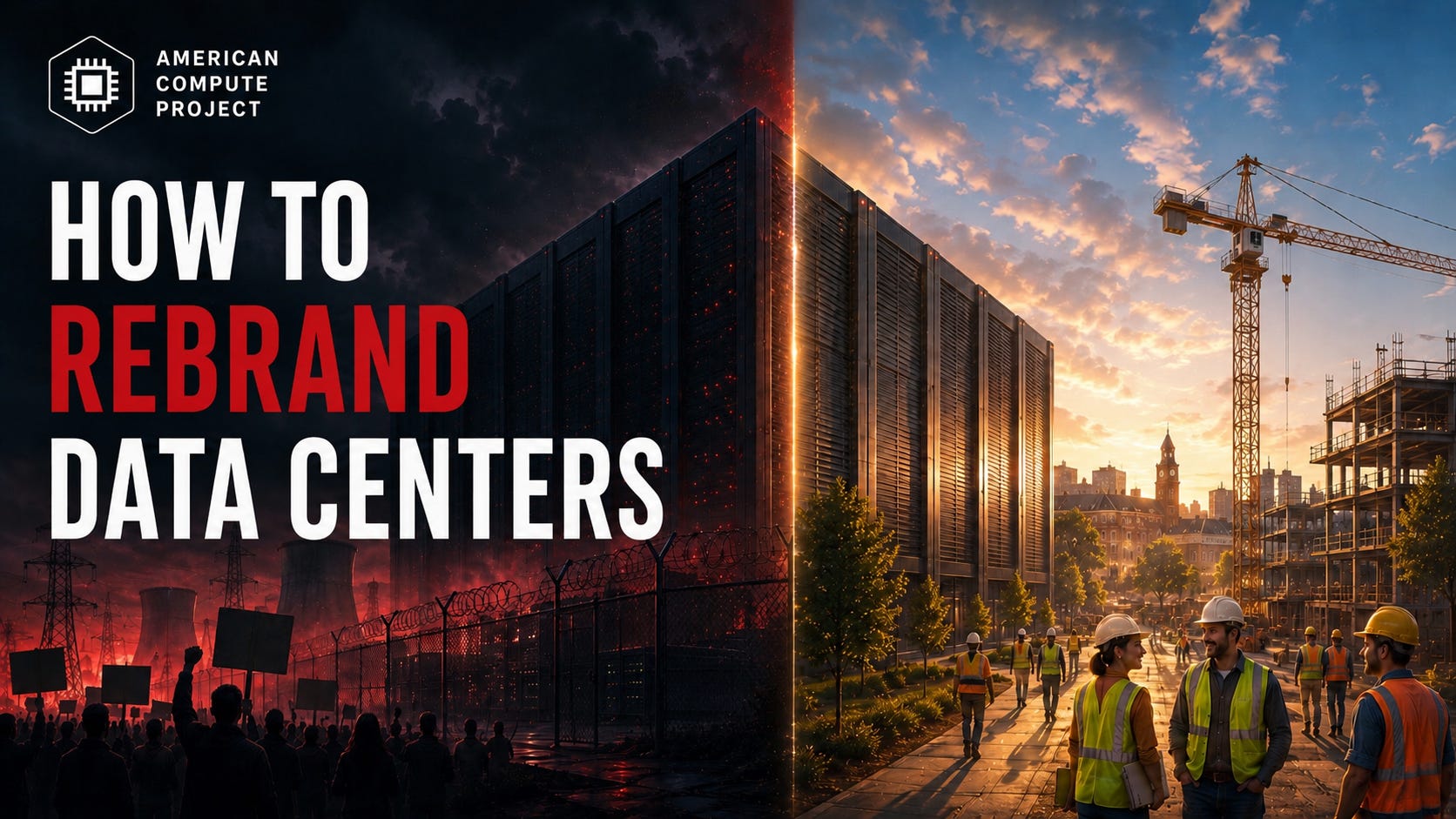
A while back, one of the great marketing minds of this or any era made a perceptive observation about the political barriers to building computing infrastructure.
“Data centers need some PR help.” President Donald Trump said in March, “because people think that if a data center goes in, their electricity prices are going to go up.”
The president made this remark while announcing the Ratepayer Protection Pledge, a commitment by tech companies to invest in new energy capacity so data center-driven demand for electricity won’t raise rates for consumers. Ratepayer protection is both a necessary policy on the merits and — as the president hinted — a measure designed to soften local resistance to new computing infrastructure.
Trump is right. Data centers are pretty unpopular right now. In January, Pew surveyed 8,512 adults and respondents said data centers are more bad than good for:
“the environment (39% vs. 4%)”
“home energy costs (38% vs. 6%)”
“and the quality of life for those nearby (30% vs. 6%).”
Public opinion becomes even more lopsided when you ask people about the possibility of a data center being built near them, as Gallup did in March.
Gallup’s survey found 71% of respondents opposed data center construction near them, with 48% being strongly opposed. And there’s one jaw-dropping data point that illustrates how extreme attitudes toward data centers have become:
“In the same March survey, 53% of Americans say they oppose building a nuclear energy plant in their area,” the report reads,” far less than the 71% opposed to data center construction.”
If this is accurate, more people would rather live near a nuclear plant than a data center than the reverse. The dangers of nuclear plants are largely mythical, of course, but it’s possible to understand why people have a knee-jerk reaction to the idea of living next to one.
Gallup’s findings on the reasons people oppose data centers are roughly what you would expect: concerns about natural resource usage, environmental impact, and utility rate hikes.
Some of these concerns have merit; others are exaggerations or outright falsehoods. Those of us who value computing infrastructure spend a lot of time reassuring people that the first set of concerns can be addressed — through measures like Ratepayer Protection — and debunking myths.
While necessary, it would be tedious and depressing to spend all of our time combatting negative messaging from data center opponents. I also believe it would ultimately be ineffective.
By repeating a claim even if only to debunk it, you’re reinforcing it in the public consciousness. The public coming to believe, “data centers are not quite as bad as people say,” would not be a good outcome.
Instead, we need a positive vision for communities— and more to the point, one’s own community — that benefit from the presence of computing infrastructure.
It’s the Local Economy, Stupid
What did the minority of people who would be open to having a data center built near them say they liked about the prospect?
According to Gallup, 66% of those who would be open to having a data center built near them mentioned local economic benefits, like jobs and tax revenue. This was by far the largest category of supportive responses.
Consistent with Gallup’s findings, respondents to the Pew survey said data centers were more good than bad for jobs and local tax revenue.
Within Gallup’s local economic benefits category, 55% cited jobs as the reason for their support. Luckily, this is one of the easiest cases to make.
Data centers are where the physical world intersects with AI progress. Electricians, plumbers, pipefitters, and linemen make dramatically more working on data centers than they do on other projects, and the new demand opens doors for workers looking to gain these skills.
You can see this play out in real world battles, like the one in Festus, where labor groups have been supportive of even controversial projects.

One challenge to this messaging is the commonly held view that data centers don’t drive employment on a long term basis because operating data centers is less labor intensive than building them. There’s something to this, but all construction work is project-based and depends on a steady stream of new projects to keep workers busy.
It also ignores the reality that data centers, like all businesses, operate within a broader economic ecosystem.
As critics often point out, data centers use a ton of power. New electrical infrastructure often has to be installed to accommodate them. People work on this infrastructure. In Mississippi, there’s been a major push to train fiber splice technicians to meet the new demands data centers have placed on the state’s fiber optic networks. And of course, there’s always economic spillover to local service businesses.
It would be worthwhile to shine a spotlight on these ancillary wins for labor and to do more outreach to constituencies that will benefit from these projects. They may not know how well positioned they are.
Another 13% of Gallup respondents mentioned local tax revenue. Here, too, there are some success stories. In Loudoun County, Virginia, about half of all tax revenue comes from data centers.
Other response types within the local economic benefits category get at the same idea, that people are motivated to support data center construction primarily by the promise of local prosperity.
Coupling Revenue and Benefits
Lately I’ve seen a few X posts about how data centers developers should “buy off” local residents. This is a reductive way to think about it. People do have preferences that aren’t strictly economic. However, it is true that they often don’t feel directly exposed to the benefits of good policies.
Any meaningful data center rebranding effort will include deals that are structured to make residents feel included in the resulting prosperity. For example, if a data center generates enormous tax revenue for the city or county, why not pair approvals with cuts to local taxes and fees?
Returning to the Loudoun County example, the county credits data center-driven revenue for its relatively low property taxes.
“Over the past ten years,” the county explained on its website, “the Board of Supervisors has lowered the real property tax rate every year from $1.145 in tax year 2016 to $0.805 cents per $100 in assessed value for tax year 2025”
There may be other ways to make people feel the impact of new revenue, and what makes sense will vary from community to community. What matters is that the benefits are broad-based and super tangible.
Meet People Where They Are
I often tell people that I’m excited about AI because it may someday yield medical miracles and spur growth on par with the Industrial Revolution. I also worry about national competitiveness and the reality that our adversaries will take up the mantle of leadership in AI if we cede it.
These points are important, and we should try to raise awareness of them and ensure they inform policy. However, the best data we have — as well as common sense — tell us most people’s concerns are closer to home. They center on jobs, revenue, and prosperity in one’s own community.
The arguments against building new data centers are deeply felt and personal to the constituencies that advance them. The case for pursuing abundance in compute must be just as targeted to people’s fears and aspirations.